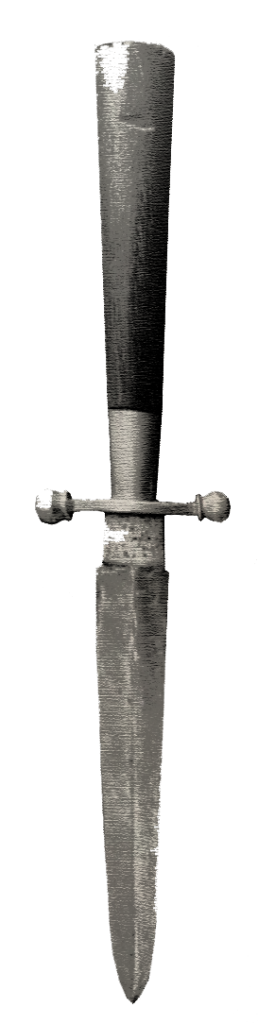
KNIFE OF VANISHMENT – A small blade of unknown provenance, reputed to bestow upon its wielder a variety of preternatural abilities or afflictions, depending on where, and how, they are cut by it.
HISTORY – An early depiction of an object which bears some similarity to the Knife of Vanishment appears in a fragment of the fourth-century Greek philosopher Dicaearchus of Messana. In his Εἰς Τροφωνίου κατάβασις (Descent into the Sanctuary of Trophonius) Dicaearchus relates the practices of the cult of Trophonius, whose oracle was said to confer upon pilgrims the “gift” of foresight—typically at the cost of madness to the supplicant:
…thereby the youth, after offering his due sacrifices and completing the rituals as instructed, was lowered into the cave of the oracle. After a time of silence, such ferocious ravings were heard from below that their echoes shook the ground beneath our feet, and even nature herself trembled with foreboding—every bird and beast fled into the nearby wood, and even the sun hid its face…
Dicaearchus goes on, offering history its first tantalizing glimpse of the Knife:
…the poor youth arose a different being than the one who was lowered in but moments prior. He had utterly lost the power of speech. His eyes were aflame with horror and confusion, his skin was the color of a raincloud, and he bore a thin red slice across the forehead.
In answer to my inquiries regarding this strange wound, a member of the cult replied that the boy had “been cut with the blade of remembrance, our holiest relic. He has seen what is to come, and he will never be the same.”
From this point on, references throughout the literature are scattered and inconsistent. This changed abruptly in the modern era, when, in the late nineteenth-century, Reginald Hollyoaks, a Magus of the Hermetic Order of the Golden Dawn, claimed possession of the knife for that organization. Hollyoaks’ testimony, written in an arcane cipher manuscript only recently decoded, provides the full extent of our knowledge of the Knife—therefore I quote his account at some length:
…the Knife of Vanishment is an object of tremendous power. It was discovered by Magus Fawn, at the founding of our order, in the year 1888.
To outward appearances the knife betrays no indication of its art: roughly twelve inches in length, with a somewhat dulled and dirty blade, it is set into a modern hilt of wood and silver, and topped with a small cross-guard.
Indeed, Magus Fawn discovered it in the care of an elderly collector of antiquities in Edinburgh, who had no notion of what he possessed. The Magus knew, however, as he had communed with the Secret Chiefs, who had guided him to its location. It was then brought to the— temple in London, where I was instructed to study its properties.
The first demonstration of the blade’s true magic came after it had been in the care of our Order for some time. A young Adept (whose name must not be spoken) was in the process of removing the knife from its scabbard for my inspection, when he accidentally cut his palm.
What happened next, I shall never forget. In one instant, a cry of pain loosed from the Adept’s lips. In the next—and before my very eyes—he was gone; he had disappeared utterly.
There was then total silence, broken only by the ringing clang of the knife striking the stone floor. I looked upon it in wonder as the last of the Adept’s blood—which had covered the blade and dripped upon the floor—itself flew away like embers on the wind.
From this time afterwards the blade was known to our Order as “The Knife of Vanishment” — although this shocking dissipation would prove to be but a small sliver of the object’s true potency…
Unsurprisingly, Hollyoaks’ scrutiny of the knife took on a more urgent form following this event. He closes his testimony by noting the results of a series of experiments upon several willing (he claims) Adepts of the Order:
My study of the knife yielded several developments, each more momentous than the last. The blade’s power to vanish the mortal form with but a quick slice to the palm was indeed confirmed – thanks to the willing sacrifices of Adepts— and—. Yet its power is greater still. This truth I discovered when I cut Adept— across the breast. He did not disappear, as I had expected, but instead rose several feet off the floor, lingering in the air for some time. Our brother found that he could control this ability at will, and by way of proof he was brought out into the street under dark of night, where he rose as high as the battlements of St. James before being urged back down.
It was after this event that I posited that the knife’s wonders were varied, not only according to the place on the body where the flesh was cut, but how it was cut also. For instance, while a horizontal slice across the palm always vanished the wounded, a vertical slice would cause a single ivory horn of glistening black to erupt from the forehead, at great agony to the afflicted.
What follows is a partial annal of cuts I have made with the Knife of Vanishment, and their resultant effects:
A cut to the back of the knee produces a rage of unequalled barbarity. Several Adepts were dismissed from the Order after this anger proved impossible to control or conceal.
A cut in the shape of a circle to the cheek would appear to cause blindness—the Adept’s eyes were seen to literally wither away, leaving only black craters. Yet this same Adept claimed that his vision was not only unaffected, but enhanced, and that he could in fact now see “the true nature of all things.” My inquiries into this “truth” proved fruitful for a time, however the Adept was reduced to the level of a babbling child after less than a fortnight.
A cut across the forehead grants the wounded forbidden knowledge, yet with a heavy cost: Adepts cut in this way were driven to almost instant madness, and could only communicate their visions in broken fragments. These ravings proved largely unintelligible, yet it was from the fevered testimony of Adept— that I discovered perhaps the knife’s greatest promise—the granting of… (missing text).For this, no prick or slice would suffice, he claimed. The blade must be plunged deep into the heart of the hopeful, who thereafter would….
The remainder of the manuscript page has been torn out. It is unknown if it survives.
PRESENT WHEREABOUTS — Hollyoaks died in 1902, and with him all mention of the knife. The object is never again discussed in the cipher texts of the Golden Dawn (though these have not all been definitively analyzed) and that organization itself was dissolved in 1903.
Dr. Gunderson, late of the University of Murkville and perhaps the world’s foremost investigator of the knife and its history, claims that although it is possible that Hollyoaks concealed the blade somewhere in England prior to his death, a more likely scenario is that the man did not actually perish in 1902, as is believed.
Though reports of the time state that Hollyoaks drowned in the English Channel, his body was never recovered, and Dr. Gunderson holds it likely that he fled to the continent, claiming the knife for his own.
Given such scant evidence, it is impossible to say whether or not the Knife of Vanishment truly exists, or whether it was merely a hoax perpetrated by Hollyoaks on a credulous public.